3 Hidden Costs Catalogues Don’t Mention: A Machine Life Cycle Analysis
#Tutorial
03/02/2026
4 min
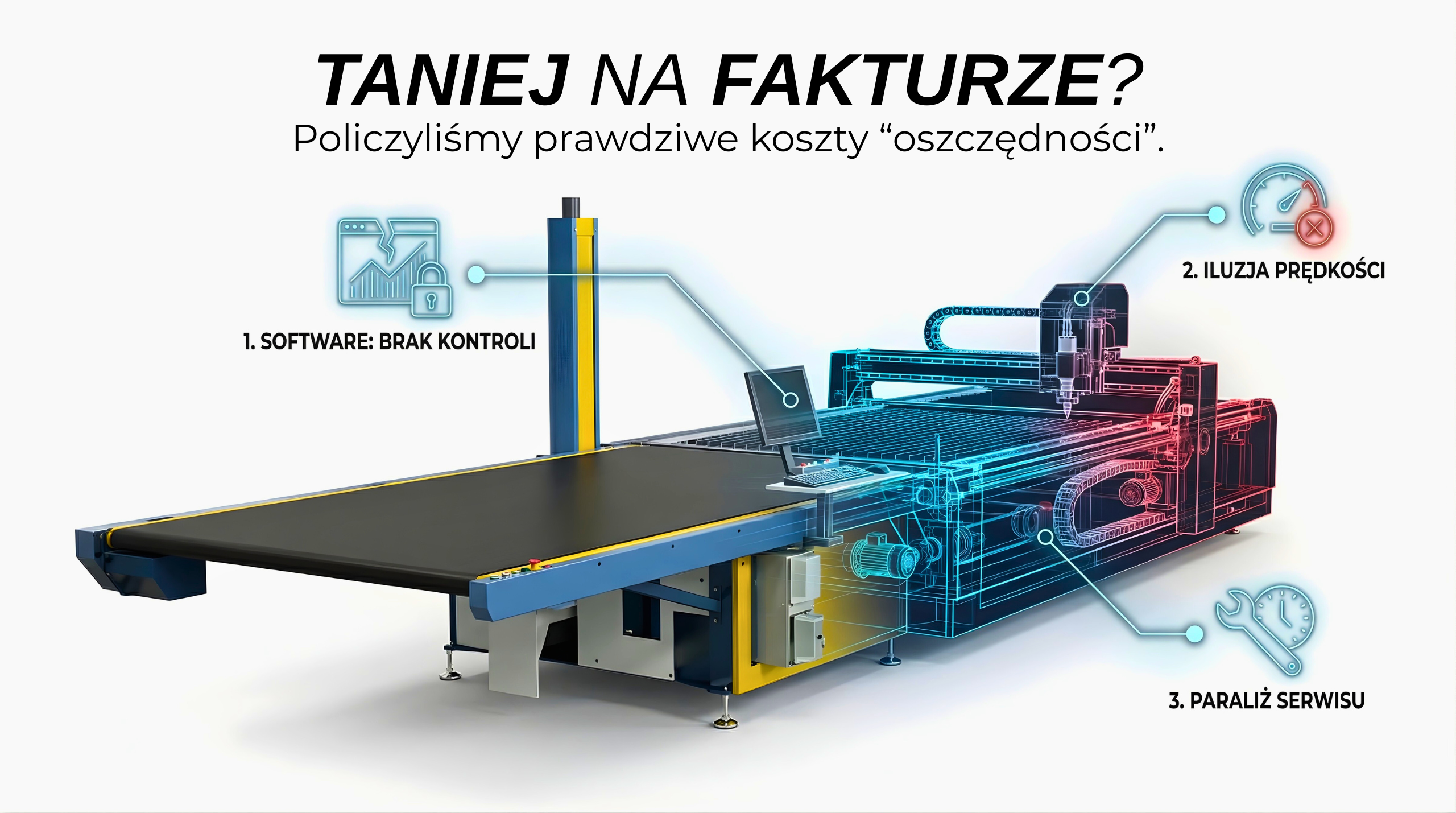
Working daily with manufacturing companies, we constantly face the same dilemma: “We have an offer for a machine with similar specs, but 30% cheaper. Is it worth paying more?”
In our “It Depends” series, the answer is always the same: it depends.
It depends on whether your goal is a low cost on the invoice or a low cost of producing a finished part. As you well know, paper will accept anything. Unfortunately, the physics of production are ruthless and quickly verify Excel spreadsheets.
Here are 3 technical areas where apparent initial savings turn into real operational losses.
1. Control Software – Unclear Data and Difficult Operation
A cutter is not just mechanics; it is primarily the software controlling the device. In budget solutions, the software and interface are often the weakest links.
Many low-cost suppliers focus on the motors but deliver systems that are unintuitive and “clunky.”
-
The Problem: Lack of clear data and reports. On a cheap machine, it is often difficult to read actual operating parameters. The system doesn’t clearly show that the machine is running slower than it should, and historical data is minimal. This prevents production managers from catching performance drops.
-
The Result: Slower operator work. When the interface is complicated, simple tasks (like uploading a file or changing parameters) take twice as long. The machine stands idle because the operator is fighting the software instead of cutting.
At Allcomp, our R&D department creates transparent software. We give the operator a tool for smooth workflow, while managers see exactly how production is performing. Additionally, we can overwrite standard functions and create custom options strictly dedicated to your project’s needs.

2. Catalog Speed vs. Real Technological Process
This is the most common market myth. A manufacturer declares a speed of 100 m/min (especially in single-ply cutters). Theoretically, the drives can reach that. In practice, this is “top speed,” often unattainable in stable production for lighter constructions.
We often see situations where production managers won’t admit a cheap machine is running much slower than assumed because the purchase decision has already been made. However, head speed isn’t everything. The key is the fluidity of the entire process: from preparation to offloading parts.
Even if a cheap machine can cut fast, you lose those gains in the process’s dead spots. If the system doesn’t support fast material preparation or if offloading finished parts blocks the machine—the efficiency of the entire line drops. “Box” suppliers rarely analyze these bottlenecks.
At Allcomp, we visit the client and design the process. We adjust the line so the entire cutting room works smoothly, eliminating downtime at the start and end. We don’t just sell a machine—we sell material flow.
3. Sewing Room Downtime and Production Paralysis
The cutting room is just one stage. Its errors or breakdowns paralyze the rest of the plant. From a production director’s perspective, the cheapest offer generates two massive hidden costs:
-
A) Cut Quality (Sewing Room Problems): An inaccurate machine generates errors: shifted notches or lack of repeatability. The cost of this error explodes in the sewing room. If parts don’t hold their dimensions, seamstresses waste time stretching and fitting “crooked” elements. Plant productivity drops because the most expensive machine is the one that generates rejects.
-
B) Maintenance (Risk of No Parts): Choosing a machine from a distant import means dealing with logistics. Distributors often claim to have stock, but in practice, it may be insufficient during a peak of breakdowns. Then, the wait for parts in a shipping container begins.
Then there is the service. No one wants to take on the servicing of unusual imported machines (outside the official distributor). When the cutter stops, the sewing room has nothing to sew. You have to send people home, which generates huge losses.
Allcomp machines are well-known in the market—this is your safety guarantee. There are many external companies capable of repairing them, and as a manufacturer, our main parts warehouse is in Poland. For us, downtime is a matter of hours, not weeks.
Summary
At Allcomp, we believe there is no such thing as a universal machine. Something that is “for everything” usually works for nothing in the industry. That’s why we don’t sell “out of the box” parameters.
We configure the machine and the process for your specific production to ensure the highest real efficiency.
Wondering if your current technology is slowing your growth? Let’s talk about numbers and processes, not catalog promises.
Fill out the form below to contact us!